Performance-Based Player Acquisition with Gaming Quests
How the Kepithor Quest Platform helps games reward real progress instead of paying for impressions, clicks and installs.
Nick Franklin · Published Jul 30th 2026
Performance-Based Player Acquisition with Gaming Quests
Game studios spend heavily to acquire players, but impressions, clicks and installs do not prove that anyone meaningfully experienced the game.
The Kepithor Quest Platform offers a performance-based alternative. Developers create a campaign around a real in-game objective, their own server verifies each completion, and Kepithor automatically sends the advertised crypto reward to the player.
Players discover these campaigns through the Kepithor Quest Hub. They can see the challenge, reward and estimated time commitment before deciding to participate.
The exchange is simple: players receive a reason to properly try a game, while developers direct campaign spend towards verified progress.
What is a gaming quest campaign?
A gaming quest campaign rewards players for completing a defined and verifiable objective.
Depending on the game, that could mean:
- Completing the tutorial and first meaningful upgrade
- Reaching a chosen player level
- Finishing a sequence of missions
- Winning a set number of battles
- Collecting or crafting a target resource
- Trying a distinctive game mode
- Reaching a milestone in a longer progression loop
The developer decides what success means and confirms it through a server-to-server verification webhook. Once a valid completion is confirmed, Kepithor handles the supported crypto payout.
Why pay for verified progress?
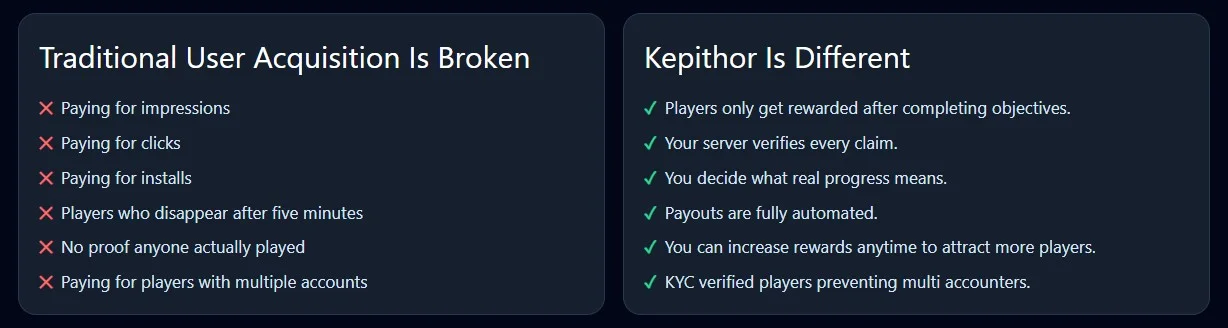
Traditional acquisition funnels can become expensive long before a user becomes an active player:
Impression → click → install → account → active player
A click can be accidental. An install can be abandoned. Even a newly created account tells you little about whether the user discovered the game’s core value.
A Kepithor quest moves the reward condition further along the journey:
Discover quest → play game → complete objective → server verification → payout
Instead of rewarding assumed interest, the campaign pays after a measurable action.
Quest campaigns do not replace awareness advertising, creator partnerships or community building. They add a performance-based channel for teams that want a clearer connection between acquisition spend and in-game engagement.
How does the experience work for players?
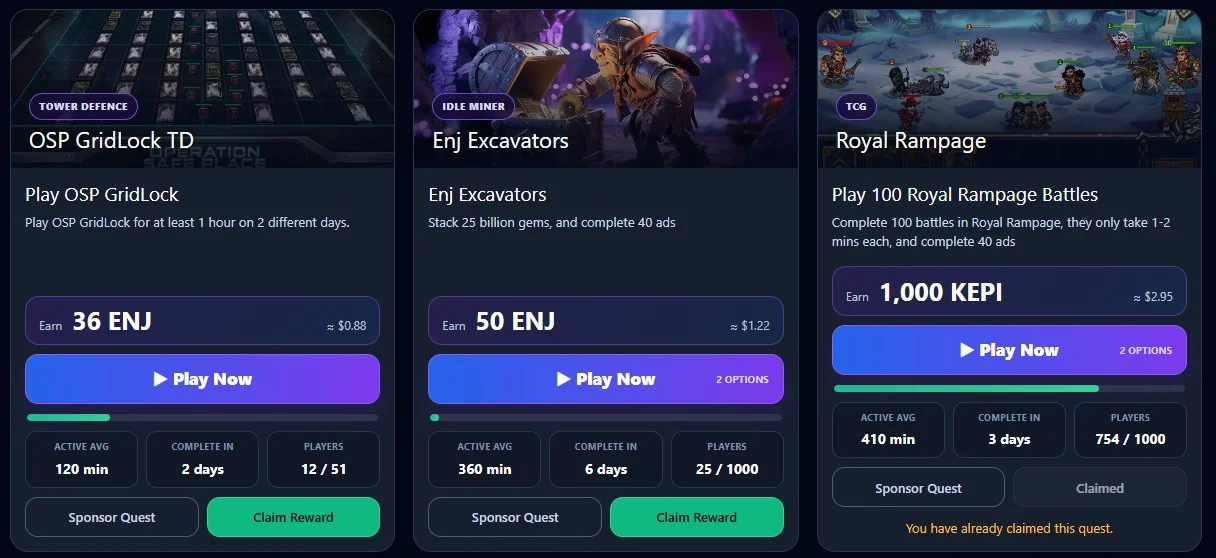
Players visit the Quest Hub and compare live campaigns. Each quest can display its objective, reward per completion, remaining reward pool and estimated active and total completion times.
The player completes the challenge and submits a claim. Your server checks the relevant progress. After successful verification, Kepithor sends the advertised reward to the player’s linked wallet.
Players must meet the relevant account requirements, including approved KYC. Identity and account checks help reduce bots, duplicate accounts and multi-account reward abuse.
For the complete player journey, see Play Games, Complete Quests and Earn Crypto with the Kepithor Quest Hub.
How do developers launch a quest?
The campaign workflow is:
1. List your game on the Kepithor Directory.
2. Create a quest for your game or eligible external project.
3. Define the objective players must complete.
4. Select the reward token and reward per completion.
5. Set the total reward pool.
6. Connect your server-to-server verification webhook.
7. Fund and launch the campaign.
8. Let players discover it through the Kepithor Quest Hub.
9. Verify valid completions so Kepithor can pay players automatically.
Because your server decides whether the objective was completed, you retain control over the event that triggers a reward.
Better objectives create better campaigns
The best objective is not necessarily the longest or most difficult. It should take a new player far enough into the experience to understand why the game is worth returning to.
An objective that is too shallow may generate completions without meaningful interest. One that is too demanding may lose players before they discover the fun.
A strong objective is:
- Meaningful: It introduces an important part of the game.
- Achievable: A new player can reasonably complete it.
- Measurable: Your server can verify it consistently.
- Clear: Players understand exactly what is required.
- Proportionate: The reward reflects the effort and time involved.
Quest copy should also distinguish between active time and total completion time. This is particularly important for idle games, construction timers and other systems that continue while a player is offline.
What makes Kepithor different?
Only pay after verified play: The reward is released after your server confirms the objective. You are not paying merely because somebody viewed an advert or installed the game.
Define your own completion event: You choose the milestone that matters to your game, provided it can be reliably verified by your server.
No blockchain game is required: Your game does not need native crypto or NFT integration. A conventional Web2 title can use the platform through the verification webhook while Kepithor handles the supported on-chain reward flow.
Automate player payouts: After a successful verification, Kepithor processes the crypto reward. Your team does not need to pay successful participants individually.
Reach KYC-verified players: Players need approved KYC before claiming quest rewards. These checks help reduce bots, duplicate accounts and reward-pool abuse.
Extend a successful campaign: When a quest finishes, developers can extend it rather than rebuilding it from scratch. The extension is designed to reach new participants.
Let supporters increase the pool: Eligible quests can receive additional community funding. Supporters can help a campaign reward more players and receive recognition on its sponsor leaderboard.
Does my game need Web3 integration?
No. The game itself does not need to use blockchain technology.
The essential technical requirement is a server capable of verifying the chosen objective through the integration webhook. Kepithor handles the currently supported crypto rewards after your server confirms a valid completion.
This separation allows conventional games to test crypto-funded acquisition campaigns without rebuilding their economies or progression systems around blockchain infrastructure.
What does the Kepithor Quest Platform cost?
The first quest campaign for each game is currently fee-free. Subsequent campaigns carry a 10% platform fee when funded.
Campaigns can currently start with as little as $10. There is no monthly subscription, advertising contract or minimum ad spend listed on the platform page.
Always confirm the latest pricing and campaign terms on the Quest Platform before funding.
Which reward tokens are supported?
The platform currently lists support for:
- USDT on BNB Smart Chain
- KEPI on BNB Smart Chain
- ENJ on Enjin Matrixchain
Supported assets and networks may expand or change. The campaign creator and live quest screens should always be treated as the current source of truth.
A more direct relationship between spend and play
Quest campaigns create a clear agreement.
The game defines a meaningful objective. The player decides whether the challenge and reward are worth their time. The developer’s server confirms the result, and Kepithor completes the payout.
This cannot guarantee long-term retention, no acquisition platform can, but it gives games the opportunity to spend on confirmed engagement instead of assumed attention.
Ready to acquire players who actually play
Explore the Kepithor Quest Platform and create a campaign built around real, verifiable progress.
Frequently Asked Questions
What is the Kepithor Quest Hub?
It is a performance-based campaign platform where games reward players for completing server-verified objectives. Kepithor handles the supported crypto payout after verification.
Does my game need blockchain or NFT integration?
No. A conventional Web2 game can use the platform if its server can connect to the verification webhook and confirm the chosen objective.
What can a quest ask players to do?
A quest can use an objective your server can reliably verify, such as completing onboarding, reaching a level, winning battles or collecting a resource, even specifiy they must be a new player.
How much does a quest campaign cost?
The first quest for each game is currently fee-free. Subsequent campaigns currently carry a 10% platform fee when funded, and campaigns can start from $10. Check the platform for current terms.
How does Kepithor reduce bots and multiple accounts?
Players need approved KYC before claiming quest rewards. Identity, device, IP, and many more account checks help reduce bots, duplicate accounts and multi-account abuse.
Which crypto rewards can campaigns use?
The platform currently lists USDT and KEPI on BNB Smart Chain, plus ENJ on Enjin Matrixchain. Confirm current support in the campaign creator or contact the team to request other tokens/chains.